New resource covers FAA SFAR 106 airline clearance, and continuous SpO2 monitoring for oxygen-dependent patients domestic and international
SAN ANTONIO, TX, UNITED STATES, May 14, 2026 /EINPresswire.com/ — RN MEDFLIGHTS PUBLISHES COMPLETE 2026 GUIDE ON FLYING WITH PORTABLE OXYGEN ON COMMERCIAL FLIGHTS WITH A LICENSED MEDICAL ESCORT
━━━━━━━━━━━━━━━━━━━━━━━━━━━━━━━━━━━━━━━━━━━━━━━━━━━━━━
New Resource Covers FAA SFAR 106 Rules, the 150% Battery Requirement, Airline Medical Clearance, and Continuous
SpO2 Monitoring for Oxygen-Dependent Patients
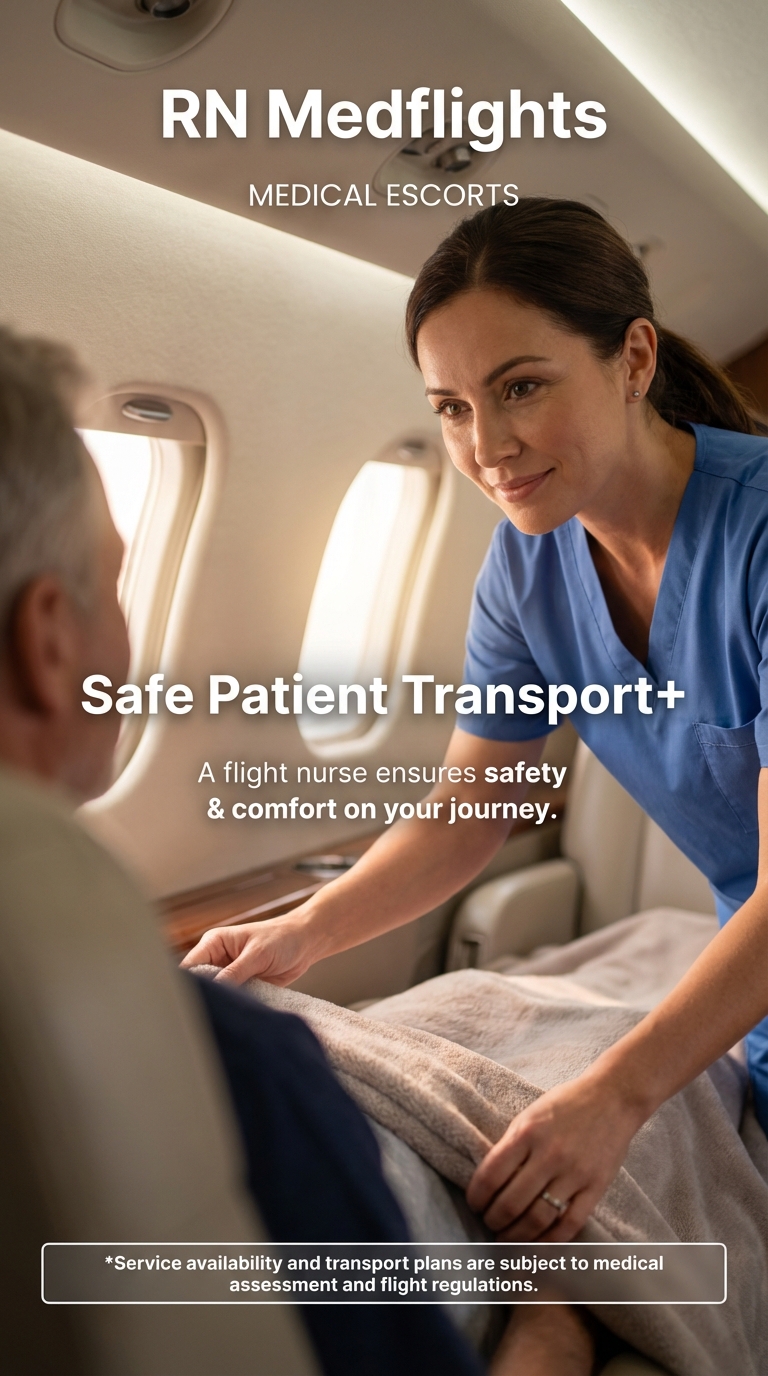
RN MEDFLIGHTS, LLC, a licensed medical escort company specializing in commercial airline patient transport, today published a comprehensive guide on flying with a portable oxygen on commercial flights — both domestic and international — with a licensed medical escort. The free resource, available at www.rnmedflights.com addresses one of the most frequently misunderstood topics in medical air travel, and provides clear, actionable guidance for An estimated 1.5 million Americans rely on supplemental oxygen daily.
“Many oxygen-dependent patients and their families believe they simply cannot fly commercially,” said Marc T. Brinsley, RN, BSN, MSN, CEO and Chief Flight Nurse of RN MEDFLIGHTS. “That is not accurate. Patients on supplemental oxygen fly safely on commercial airlines every day — with the right device, the right preparation, and a licensed nurse managing
everything in real time. Our guide explains exactly how it works, in plain language that any family can follow.”
OXYGEN ON COMMERCIAL FLIGHTS: WHAT PATIENTS NEED TO KNOW
Under FAA Special Federal Aviation Regulation 106 (SFAR 106), passengers are permitted to use FAA-approved Portable Oxygen Concentrators (POCs) on commercial flights. Unlike oxygen tanks — which store compressed gas and are prohibited on all commercial aircraft — a portable oxygen concentrator draws oxygen from surrounding cabin air and delivers it to the patient continuously and safely.
However, compliance requires careful preparation. Airlines do not provide supplemental oxygen to passengers. Patients must bring their own FAA-approved device, obtain a physician’s letter confirming the medical need and prescribed flow rate, and notify the airline at least 48 to 72 hours before departure. For international flights, the process is more complex — requiring a full Medical Information Form (MEDIF) submitted to the airline’s medical department and compliance with the destination country’s aviation authority rules in addition to FAA requirements.
THE 150% BATTERY RULE — THE MOST COMMONLY MISSED REQUIREMENT
The most frequently misunderstood oxygen travel requirement is what the FAA calls the 150 percent battery rule. Under this regulation, an oxygen concentrator must carry enough battery life to operate for one and a half times the total expected journey time — including ground delays, taxiing, and layovers — not just time in the air.
For a ten-hour international flight with two hours of ground time, a patient must carry at least eighteen hours of battery capacity. Missing this calculation can result in being denied boarding or, more dangerously, running out of oxygen mid-flight. The RN MEDFLIGHTS guide includes a practical battery calculator tool to help families calculate exact requirements before travel.
WHY OXYGEN MANAGEMENT REQUIRES CLINICAL SUPERVISION
Commercial aircraft cabins are pressurized to the equivalent of approximately 6,000 to 8,000 feet above sea level — where approximately 25 percent less oxygen is available than at sea level. For healthy travelers this is not a concern, but for patients with COPD, congestive heart failure, pulmonary fibrosis, or post-surgical recovery, this reduction in available oxygen can cause a clinically significant drop in blood oxygen saturation (SpO2).
A target SpO2 of 95 percent or above is recommended throughout the flight for oxygen-dependent patients. Without a trained clinician monitoring saturation levels and adjusting the device’s flow rate in real time, a gradual drop can go unnoticed until it becomes a medical emergency.
RN MEDFLIGHTS escort nurses monitor SpO2 continuously using portable pulse oximeters, adjust flow rates based on real-time clinical readings, manage battery rotation to ensure uninterrupted oxygen delivery, and are trained in Advanced Cardiovascular Life Support to respond immediately to any change in the patient’s respiratory status.
“Battery management alone on a 14-hour international flight can require five or more rotations between battery packs,” Brinsley noted. “Managing that correctly while also navigating international airports, connections, and customs — while monitoring a patient’s clinical status — is not something a family member untrained in aeromedical care should be expected to handle alone.”
DOMESTIC AND INTERNATIONAL: KEY DIFFERENCES
The guide addresses a critical distinction that most patients and families are unaware of: domestic US flights and international flights operate under significantly different oxygen rules. Domestic flights are governed solely
by FAA SFAR 106. International flights must also comply with the destination country’s aviation authority — which may have separate device approval requirements — and typically demand longer battery capacity, full MEDIF documentation, and in some cases, customs declarations for medical equipment crossing international borders.
A number of major international carriers including Emirates, Qatar Airways, Lufthansa, British Airways, and Turkish Airlines offer in-cabin oxygen programs on select routes, but these require extensive advance coordination.
Most passengers continue to rely on personal FAA-approved devices.
ABOUT THE GUIDE
The complete 2026 guide — Flying with Portable Oxygen on a Commercial Flight: The Complete Medical Escort Guide — is published free of charge at www.rnmedflights.com and covers FAA SFAR 106 requirements, the 150 percent battery rule with an interactive calculator, an airline-by-airline rules comparison, approved POC device models, the physiological effects of cabin altitude on oxygen-dependent patients, and a step-by-step breakdown of how RN MEDFLIGHTS manages every aspect of oxygen transport from pre-departure equipment verification through final clinical handoff
at the destination. http://www.rnmedflights.com/post/post-flying-with-portable-oxygen-commercial-flight-medical-escort-guide
RN MEDFLIGHTS, LLC is a licensed, veteran-owned medical escort company headquartered in San Antonio, Texas. The company provides non-emergency commercial airline patient transport services — domestic and international — including medical escort, international repatriation, air ambulance alternatives, stretcher services, and oxygen-dependent patient management.
All escorts are licensed Registered Nurses or Advanced Paramedics with a minimum of five years of ICU or emergency department experience. RN MEDFLIGHTS operates 24 hours a day, 7 days a week.
Phone: 210-901-5226 | Toll-Free: 1-877-354-7049
Email: info@rnmedflights.com
Marc Brinsley
RN MEDflights LLC
email us here
Visit us on social media:
LinkedIn
Facebook
X
Legal Disclaimer:
EIN Presswire provides this news content “as is” without warranty of any kind. We do not accept any responsibility or liability
for the accuracy, content, images, videos, licenses, completeness, legality, or reliability of the information contained in this
article. If you have any complaints or copyright issues related to this article, kindly contact the author above.

Media gallery