How colleges can help students connect learning to careers earlier, strengthen engagement, and support persistence
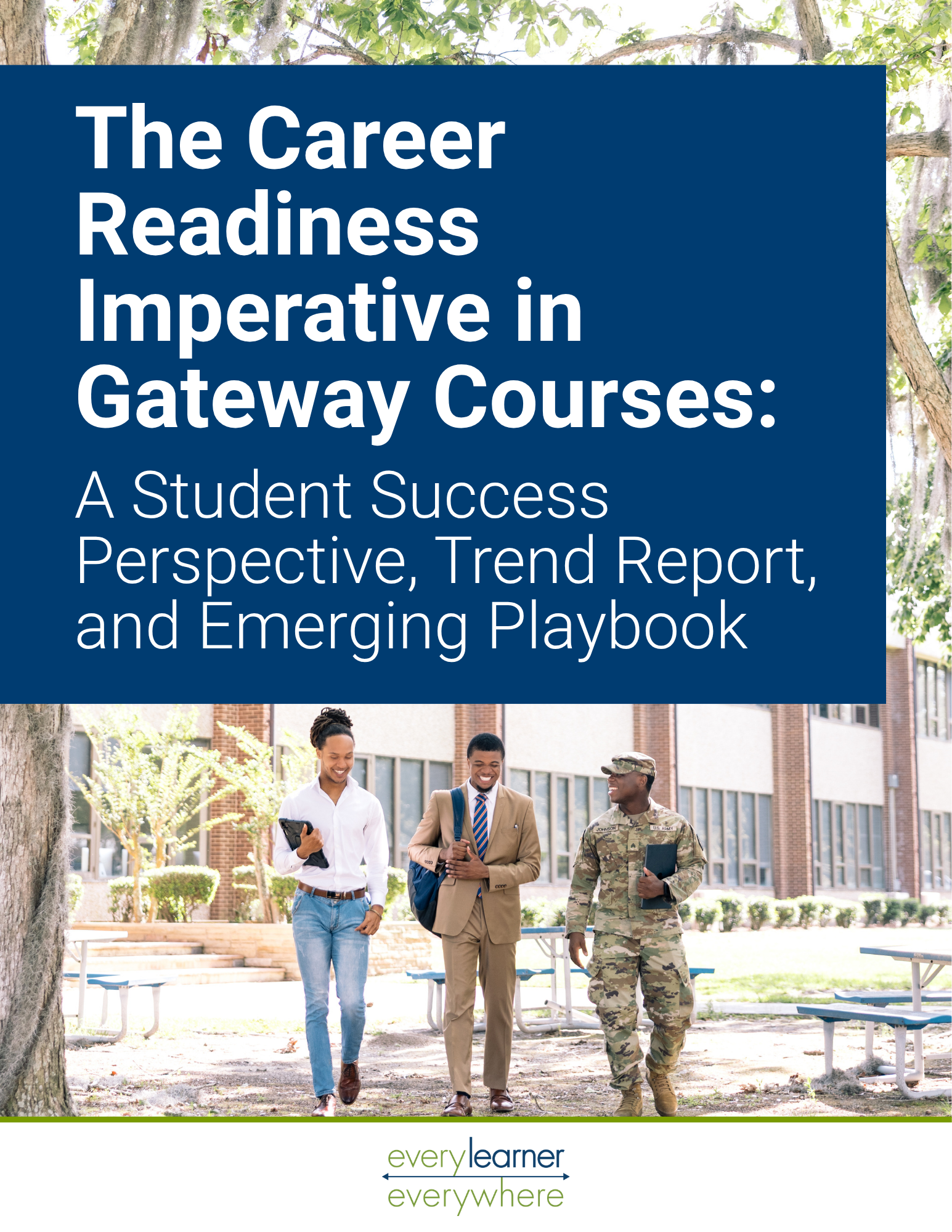
BOULDER, CO, UNITED STATES, April 21, 2026 /EINPresswire.com/ — Every Learner Everywhere today announced the release of The Career Readiness Imperative in Gateway Courses: A Student Success Perspective, Trend Report, and Emerging Playbook, a new resource examining how colleges and universities are integrating career readiness into academic courses, especially gateway and general education classes. The report makes the case that helping students understand the career value of what they learn should be a shared institutional priority, beginning early in the college experience.
The report draws on a scan of academic research, institutional materials, and interviews with 17 higher education experts conducted in late 2025. It finds that students increasingly want clearer answers to a simple question: “How will this course help me get a job?” and that many institutions are responding by bringing career competencies into the classroom rather than leaving them only to career centers and co-curricular programming.
“A growing number of programs are not waiting until a capstone project and an interviewing workshop in the senior year to help students connect academic success with professional success,” said Robert McGuire, the report’s author. “They see that students benefit from experiencing the career relevance of their education early, explicitly, and consistently.”
Why It Matters
The report highlights a growing mismatch between student expectations and the ways colleges traditionally communicate the relevance of coursework. It notes that students often make enrollment decisions based on future job opportunities, yet many do not feel their programs adequately prepare them for the workforce. The report argues that this disconnect can affect persistence, belonging, and confidence in higher education.
The report also emphasizes access: gateway courses reach the broadest range of students, including many who may never visit a career center or who may be weeks away from stopping out of college. By embedding career relevance in these early courses, institutions can make career readiness part of the standard academic experience rather than a benefit reserved for students who already know how to navigate campus resources.
Major Findings
The report identifies eight major trends shaping how higher education is approaching career readiness in the curriculum. Among them: career readiness is moving from co-curricular spaces into classrooms; institutions are building on shared frameworks such as The National Association of Colleges and Employers competencies and the Association of American Colleges & Universities rubrics; and career readiness is shifting from isolated experimentation to planned, campuswide strategy.
The report also finds that gateway courses are especially powerful places to make career relevance visible, because they reach large numbers of students early in their academic journeys. The report argues that the first intervention is often translation—helping students recognize and articulate the durable, transferable skills already embedded in coursework.
“The experts interviewed for this repeatedly emphasized that they don’t cut any core academic material in favor of technical skills,” McGuire said. “They help students improve just by finding small moments to connect the dots between what a course teaches and what employers say they value.”
Practical Playbook
An emerging playbook in the report offers concrete steps for faculty, teaching and learning centers, career services staff, and academic leaders. Recommended practices include adding short reflection prompts, using clear competency language in syllabi and assignments, and creating modular career readiness lessons that faculty can easily adapt through the learning management system.
The report showcases examples from institutions such as the University of Connecticut, Indiana University Indianapolis, the University of Tampa, Georgia Southern University, Washington State University, Dallas College, the University of South Florida, Georgia Institute of Technology, and University of Denver that are embedding career competencies into required courses and building stronger collaboration across campus units.
The Career Readiness Imperative in Gateway Courses is freely available through the Every Learner Everywhere resource library and is licensed under a Creative Commons Attribution-No Derivatives 4.0 International License. The report is intended for faculty, program directors, and administrators seeking practical, intellectually serious approaches to linking academic learning with career preparation.
To download The Career Readiness Imperative in Gateway Courses or learn more about Every Learner Everywhere and its collaborative approach to equitize higher education through digital learning, visit everylearnereverywhere.org. To contact Every Learner Everywhere, email everylearner@wiche.edu, or call (303) 541-0208. Follow Every Learner on LinkedIn at Every Learner Everywhere.
Emilie Cook
Every Learner Everywhere | WCET
+1 303-541-0208
email us here
Visit us on social media:
LinkedIn
YouTube
Legal Disclaimer:
EIN Presswire provides this news content “as is” without warranty of any kind. We do not accept any responsibility or liability
for the accuracy, content, images, videos, licenses, completeness, legality, or reliability of the information contained in this
article. If you have any complaints or copyright issues related to this article, kindly contact the author above.

Media gallery