
Key Takeaways
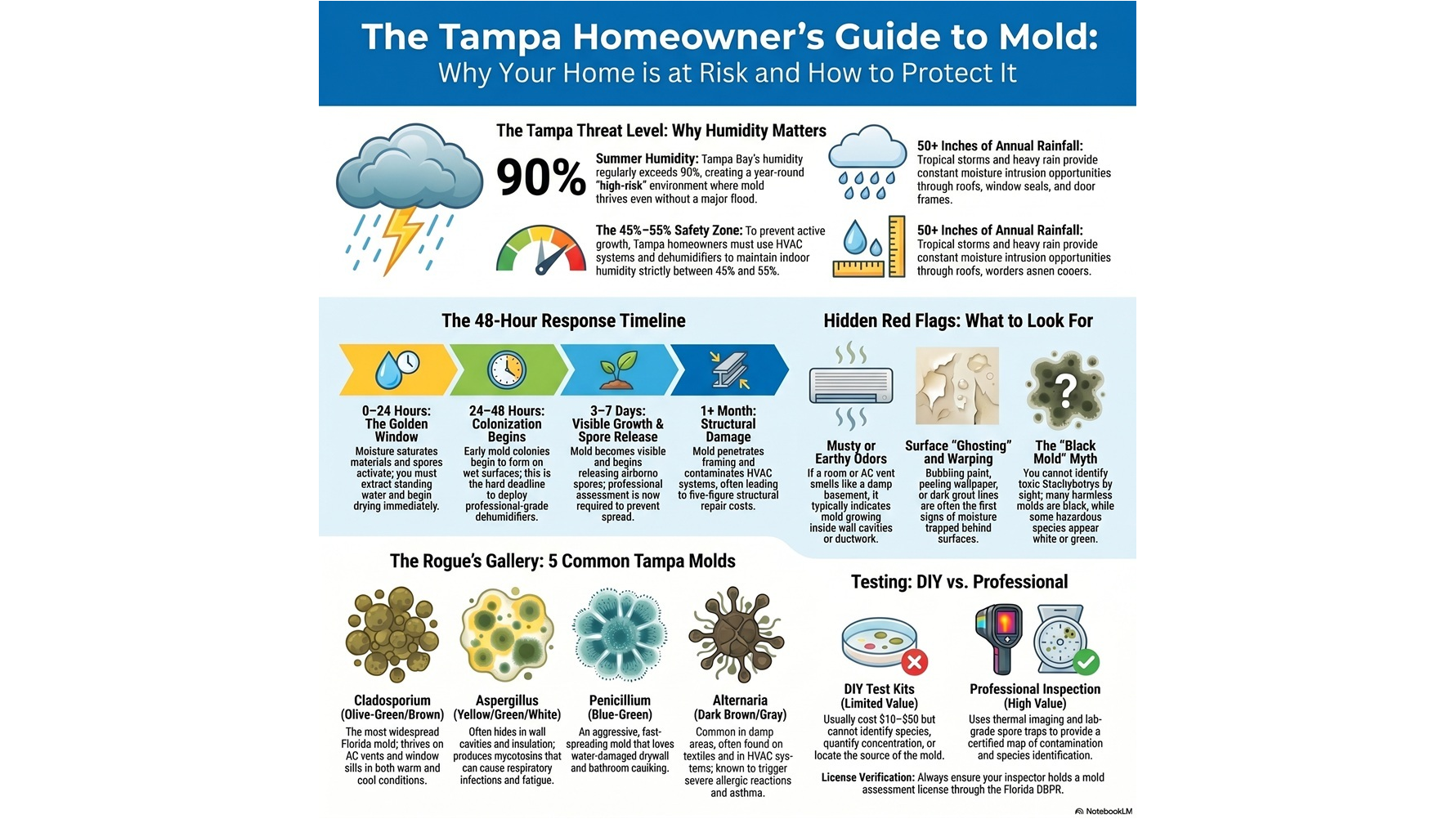
- Mold spores can begin germinating on wet surfaces in as little as 24 to 48 hours after water enters a Tampa home — a timeline established by the IICRC and backed by environmental science.
- Tampa’s summer humidity routinely exceeds 70-90%, making it one of the most mold-vulnerable cities in the country — Florida ranked #1 in the nation for mold risk in a March 2024 study.
- “Black mold” cannot be identified by color alone — lab testing is the only reliable way to confirm Stachybotrys chartarum or any other specific species.
- Mold most commonly hides in crawl spaces, HVAC systems, and wall cavities long before any visible sign appears — meaning most Tampa homeowners don’t know they have a problem until it’s already serious.
- Catching mold early can mean the difference between a minor repair bill and a five-figure remediation project — the 48-hour window is the most critical factor in keeping costs manageable.
Tampa homeowners face something most people in other parts of the country simply don’t encounter at the same scale: a climate that works against them every single day. The heat, the rain, the humidity — all of it creates an environment where mold doesn’t need an invitation. It just needs a damp surface and a little time.
Tampa’s Climate Starts the Clock Immediately
The moment moisture enters a Tampa home — whether from a burst pipe, a roof leak, storm-driven rain, or even a slow drip behind the refrigerator — the conditions for mold growth are essentially already met. Tampa Bay’s baseline outdoor humidity regularly climbs past 70% in summer, and indoor humidity in an air-conditioned home can still exceed the 60% growth threshold if the HVAC system is undersized, poorly maintained, or turned off during vacancy.
Mold spores don’t need to be introduced into a home — they’re always present in the air. What they need is moisture and an organic surface to feed on. In Tampa, those two ingredients coexist year-round, which means there’s no safe season, no dry spell long enough to reset the risk, and no water intrusion event small enough to ignore.
The IICRC — the Institute of Inspection, Cleaning and Restoration Certification, which sets the professional standard for water damage and mold response — establishes that mold growth typically begins within 24 to 48 hours of water damage. In Tampa’s ambient conditions, that timeline is not a worst-case estimate. It’s the baseline. TampaBayMold.net, a Tampa-based mold inspection specialist, emphasizes that the 48-hour window is not a cushion — it’s a hard deadline that Tampa’s climate enforces without exception.
What Happens Inside Your Home After Water Intrusion
Most homeowners picture mold as something that appears gradually over weeks. The reality is far faster — and far more consequential. The growth timeline breaks into distinct phases, each one harder and more expensive to address than the last.
0-48 Hours: Spores Activate on Wet Surfaces
In the first 24 to 48 hours after a water intrusion event, the damage that’s visible — the puddle on the floor, the wet ceiling tile, the soaked carpet — is only part of the story. Porous building materials like drywall, wood framing, and insulation begin absorbing moisture almost immediately, and that internal saturation is what matters most. A drywall panel can feel completely dry on the surface while holding significant internal moisture — well above the threshold needed to sustain active mold germination.
During this window, mold spores already present on those surfaces begin activating. They don’t need to travel in from outside. They’re already there, dormant, waiting for exactly this moment. This is why rapid drying within the first 24 hours — using commercial-grade dehumidifiers and high-velocity air movers — can prevent mold from establishing entirely. Once the 48-hour mark passes without intervention, the situation changes significantly.
72 Hours-3 Weeks: Visible Colonies, Spore Release, and Spreading Penetration
Between 72 hours and the end of the first week, visible mold colonies can begin appearing on wet drywall, wood surfaces, and insulation. Species like Penicillium — a fast-spreading, blue-green mold common in Tampa homes — can establish a recognizable colony on water-damaged drywall within days. What’s visible on the surface, though, is only the leading edge of what’s growing inside the material.
By the end of the first week, active colonies are releasing spores into the air. Those airborne spores don’t stay put — they travel through the home’s air currents and HVAC system, landing on new surfaces and starting the process over in rooms that had no direct water exposure. From weeks one through three, mold begins penetrating deeper into porous materials — moving through the paper facing of drywall into the gypsum core, spreading along wood grain in floor joists, and establishing new colonies in adjacent wall cavities.
By this stage, surface-level cleaning is no longer a realistic solution. The affected materials themselves have become the growth medium, and remediation requires physical removal and replacement, not just treatment.
Beyond 1 Month: Deep Material Damage and HVAC-Wide Contamination
After a month of unchecked growth, a mold problem that started with a single water intrusion event can become a home-wide contamination issue. Mold that has penetrated wood framing begins compromising structural integrity. Colonies established inside HVAC ductwork — specifically on evaporator coils, drain pans, and duct lining — turn every air conditioning cycle into a spore-delivery system, pushing contamination into every room simultaneously.
This is the stage where remediation costs escalate dramatically. A problem caught in the first 48-72 hours may cost relatively little to address. The same problem discovered after a month of unchecked spread can run $10,000 to $30,000 — and in cases involving structural wood damage or whole-house HVAC contamination, significantly more. In Tampa’s climate, the escalation from manageable to catastrophic happens faster than in almost any other region in the country.
Why Humidity Makes Tampa Exceptionally High-Risk
Mold is a universal problem, but Tampa’s specific climate combination — persistent heat, extreme humidity, heavy rainfall, and a year-round growing season — creates conditions that push local risk far above the national average. Understanding exactly why Tampa sits at the top of the mold-risk map puts the urgency of the 48-hour window into clear context.
Florida Consistently Ranks Among the Nation’s Worst States for Mold
A March 2024 study measuring mold risk across all 50 states scored Florida at 38.76 out of a possible 40 on the FDP Mold Index — ranking it #1 in the nation. The index factors in average rainfall, temperature, humidity, and the age of the housing stock. Florida’s score wasn’t close — it sat at the absolute ceiling of the scale. For Tampa homeowners, that ranking isn’t abstract. It reflects the real, day-to-day environmental pressure that every home in the region faces, regardless of how well-maintained it is.
Florida’s combination of over 50 inches of annual rainfall, a tropical storm season running June through November, and warm temperatures that persist year-round means the conditions for mold growth never fully switch off. There is no dry, cold season that gives Tampa homes a natural recovery window the way colder climates experience each winter.
Tampa’s Summer Humidity Routinely Exceeds the 60% Mold Growth Threshold
The U.S. Environmental Protection Agency recommends keeping indoor relative humidity below 60% — ideally between 30% and 50% — to discourage mold growth. Most mold species can sustain active growth at 60% or above, with optimal growth occurring above 70%.
Tampa Bay’s summer humidity regularly exceeds 70-90% outdoors, and that pressure bleeds indoors. Even in air-conditioned homes, indoor humidity can climb past 60% if the HVAC system isn’t properly sized for Tampa’s load, isn’t running during away periods, or hasn’t been serviced recently. The practical implication is that maintaining indoor humidity consistently between 35% and 50% isn’t optional in Tampa — it’s the single most effective mold prevention measure available to homeowners, outside of immediate response to water intrusion events.
“Black Mold” Cannot Be Identified by Sight
One of the most persistent and genuinely dangerous misconceptions about mold is the idea that dark-colored growth equals “toxic black mold.” That assumption leads homeowners to either panic unnecessarily over harmless species — or, worse, dismiss genuinely hazardous growth because it doesn’t look the way they expected.
Why Color Is an Unreliable Indicator of Species or Toxicity
Stachybotrys chartarum — the species formally known as toxic black mold — does present as a dark greenish-black, slimy-looking growth. But so do common, relatively low-risk species like certain strains of Cladosporium and Alternaria. Meanwhile, Aspergillus — a genus with multiple species capable of producing dangerous mycotoxins — can appear yellow, white, green, or brown. Penicillium is typically blue-green. Some hazardous molds appear almost white.
What Lab Testing Actually Confirms
Professional mold testing uses calibrated air sampling equipment, surface swabs, and bulk material samples sent to an accredited third-party laboratory. Results — typically returned within 3 to 5 business days — include full species identification, spore count per cubic meter of air, and a comparison against outdoor baseline samples collected at the same time. That data package answers three questions no visual inspection can address: what is growing, how much is present, and whether the levels are elevated above what’s normal for the outdoor environment.
Professional lab reports are also accepted by remediation contractors, insurance adjusters, and real estate attorneys — a practical value that DIY test kits, which cannot identify species or measure concentration, simply cannot provide. When a remediation decision involves significant cost or a real estate transaction, the test result backing that decision needs to hold up to scrutiny.
Where Mold Hides Before You Notice It
The visible mold a Tampa homeowner notices — a dark smudge on a bathroom ceiling, a fuzzy patch near a window frame — is rarely the whole story. In most serious mold situations, the visible growth is the symptom of a much larger colony already established somewhere out of sight. Knowing where to look is the fastest path to early detection.
Crawl Spaces: Tampa Bay’s Single Highest-Risk Mold Zone
A significant portion of Tampa Bay homes are built on crawl spaces rather than slabs — and those crawl spaces represent the highest-concentration mold risk in the local housing stock. Ground moisture migrating upward through unprotected soil, inadequate or damaged vapor barriers, poor ventilation, and direct wood-to-soil contact create conditions that are almost purpose-built for mold establishment. Many Tampa homeowners haven’t entered their crawl space in years — and in some cases, active mold colonies have been growing on floor joists, subfloor panels, and insulation throughout that entire period.
The moisture in an unprotected crawl space doesn’t stay contained. It migrates upward into living spaces, driving up indoor humidity throughout the entire home and fueling mold growth in bathrooms, kitchens, and bedrooms — even with no direct water intrusion occurring above the foundation. What to look for on a crawl space inspection:
- Dark discoloration or fuzzy growth on wood floor joists or subfloor panels
- Damaged, sagging, or missing vapor barrier plastic sheeting
- Standing water or persistently wet soil
- Deteriorating or compressed insulation with visible discoloration
- A strong musty odor upon entry — even without visible growth
- Efflorescence (white mineral deposits) on concrete block walls, indicating water migration through the foundation
If a crawl space has no vapor barrier — or an existing barrier that’s damaged or incomplete — that is the single highest-value mold prevention upgrade available to a Tampa homeowner. A properly installed 6-mil or thicker polyethylene vapor barrier dramatically reduces ground moisture migration and lowers crawl space humidity levels throughout the year.
HVAC Systems Spread Spores Room to Room
Tampa’s air conditioning systems run almost continuously — and that constant operation creates a specific mold risk that sits at the center of the home’s air distribution network. The evaporator coil and drain pan inside the air handler are perpetually wet during operation, creating a direct mold growth opportunity on equipment that circulates air through every room. When mold establishes on a coil or inside ductwork, every AC cycle becomes a spore-delivery event — pushing contamination simultaneously into bedrooms, kitchens, living areas, and any other room the duct system reaches.
HVAC-sourced mold is particularly difficult to detect without professional equipment because the growth is entirely hidden inside mechanical enclosures and ductwork. A persistent musty smell that intensifies when the air kicks on — especially in a home with no obvious water damage history — is often the only early warning sign. Annual HVAC inspection and duct cleaning is fundamental indoor air quality maintenance in Tampa Bay, not optional upkeep.
Wall Cavities, Subfloors, and Under-Sink Cabinets
Wall cavities are among the most common locations for serious, long-term hidden mold growth in Tampa homes. Moisture that enters through roof leaks, window seal failures, or plumbing supply line drips can saturate drywall and wood framing inside a wall for weeks before any surface sign appears. By the time paint begins bubbling or a musty smell becomes noticeable, the colony is typically already well-established and has often spread to adjacent stud bays.
Subfloor material beneath bathrooms — particularly around toilets, tubs, and showers with aging caulk or grout lines — absorbs moisture slowly over time. Spongy or soft wood flooring near plumbing fixtures is almost always a sign that mold has already penetrated the subfloor. Under-sink cabinets, both in kitchens and bathrooms, are high-frequency mold zones because slow supply line drips and drain connection leaks go undetected for months in an enclosed, dark space. Routine monthly checks under all sinks — looking for moisture staining, warped cabinet flooring, or early discoloration — catch problems in this zone before they spread to adjacent walls and framing.
How Waiting Turns a Minor Fix Into a Major Bill
The cost of mold remediation isn’t fixed — it scales directly with how long the problem has been developing and how far it has spread. The speed of that escalation in Tampa’s climate is genuinely faster than most homeowners expect.
Professional Restoration Within 24 Hours Can Prevent a Five-Figure Repair
A mold colony caught within the first 24 to 48 hours of a water intrusion event — before it has penetrated porous materials or spread beyond the initial impact zone — can often be addressed for a relatively modest cost. That same colony discovered three to four weeks later, after it has migrated through drywall into wall framing and spread to adjacent rooms, can easily cost $2,368 for a typical case — and that figure climbs steeply from there. Extensive whole-house remediation, particularly cases involving structural wood damage or full HVAC contamination, runs $10,000 to $30,000 or more.
Professional water damage restoration firms that respond within 24 hours of an intrusion event — deploying commercial dehumidifiers, high-velocity air movers, and moisture meters to verify complete drying — can prevent mold from establishing at all in many cases. That intervention window is narrow, but it’s real. The cost difference between acting within 24 hours and acting after three weeks is not marginal. It’s often the difference between a service call and a major construction project.
How Mold Penetration Into Materials Drives Cost Escalation
The reason costs escalate so sharply is straightforward: once mold has penetrated a porous material, cleaning the surface is no longer sufficient. The contaminated material has to be physically removed, safely contained, and replaced. Drywall that has been mold-colonized beyond the surface paper layer must be cut out and replaced — and any wood framing behind it that has also been affected must be treated or replaced as well. When that penetration spreads across multiple wall sections, into floor systems, or into the structural framing of a roof, the scope of the rebuild grows with it.
In Tampa’s climate, this escalation happens quickly because the ambient conditions that allowed the mold to establish — heat, humidity, moisture trapped inside materials — continue sustaining active growth every single day the problem goes unaddressed. The clock doesn’t pause because a homeowner is busy or uncertain about next steps. It keeps running.
The 48-Hour Window Won’t Wait — Neither Should You
Tampa’s climate doesn’t offer homeowners the grace period that drier, cooler regions might. The 48-hour colonization window isn’t a statistical average or a worst-case scenario — it’s the standard timeline, backed by IICRC guidelines, environmental science, and the real-world experience of local remediation professionals. And it applies to any water intrusion event, large or small.
The most effective protection strategy for a Tampa home combines three things working together: consistent indoor humidity control maintained between 35% and 50%, an immediate-response protocol for any water intrusion event that begins drying within the first 24 hours, and scheduled professional inspections covering crawl spaces, HVAC systems, and high-moisture zones at least annually. That combination doesn’t eliminate mold risk — nothing does in Tampa’s climate — but it keeps that risk manageable and the financial consequences minor rather than catastrophic.
Routine professional mold inspection is the only tool that reliably finds hidden growth before it reaches the expensive stage. alibrated air sampling detects elevated spore concentrations in rooms with no visible growth. Moisture meters confirm whether building materials are truly dry or still holding enough internal moisture to sustain active colonization. These are not tools available to the average homeowner — they’re why professional assessment delivers a fundamentally different level of detection than a visual walkthrough.
The 48-hour window is unforgiving, and Tampa’s climate makes sure of it. Every hour of delay after water enters a home is an hour that active colonization is either beginning or advancing — and the materials, costs, and health consequences grow with every stage that passes without intervention.
For Tampa homeowners who want region-specific guidance on identifying, testing, and addressing mold before the 48-hour window closes, TampaBayMold.net provides local mold inspection and testing services built specifically for the conditions Tampa homes face year-round.
TampaBayMold.net
550 N. Reo St. Suite #300
Tampa
FL
33609
United States


