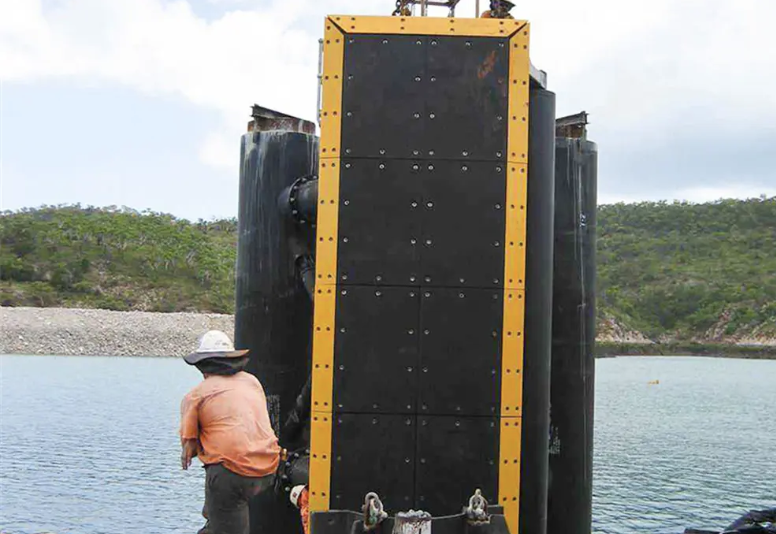
TIANJING, CHINA, August 19, 2026 /EINPresswire.com/ — The marine environment is arguably one of the most unforgiving settings for engineering materials. Constant exposure to high-salinity seawater, extreme UV radiation, and the immense kinetic energy of berthing vessels necessitates shielding solutions that are both durable and resilient. Within this context, the performance of dock protection systems relies heavily on the quality of facing pads. As a Trusted UHMWPE Sheet Manufacturer in China, we have observed a critical shift in global procurement standards: the transition from extruded materials to compression-molded Ultra-High Molecular Weight Polyethylene (UHMWPE). This technical study examines why the molecular integrity and mechanical properties of compression-molded sheets are essential for marine safety and how specific manufacturing methodologies define the lifespan of port infrastructure.
I. The Molecular Foundation: Why Method Matters in Marine Engineering
The fundamental difference between compression molding and extrusion lies in how the polymer chains are treated during the thermal transition. UHMWPE is characterized by its exceptionally long chains, with a molecular mass usually ranging between 3.5 and 9 million g/mol. This high molecular weight is precisely what gives the material its signature impact resistance and self-lubricating properties.
In the extrusion process, the material is forced through a die using a screw. This method subjects the polymer to high shear stress, which can lead to “molecular shearing.” When these long chains are broken down into shorter segments to facilitate flow through an extruder, the resulting sheet may look identical to a molded one, but its internal “skeleton” is compromised. Conversely, compression molding—the specialty of BEYOND—uses a low-shear, long-cycle sintering process. By applying consistent pressure and heat over an extended period, the polymer chains remain intact and reach a state of maximum entanglement. For marine fender facings, this translates to a material that can absorb repeated heavy impacts without cracking or deforming.
II. Comparative Performance: Impact Strength and Stress Distribution
Marine fenders do not just sit in the water; they act as the primary energy absorbers during the docking of massive cargo ships. A technical comparison of BEYOND’s UHMWPE-1000 series reveals why compression molding is the superior choice for these high-stakes applications.
1.Impact Energy Absorption: Compression-molded UHMWPE exhibits significantly higher Izod impact strength. In our laboratory tests, molded samples demonstrated a notched impact strength exceeding 140 kJ/m2, whereas extruded versions often show a 20-30% reduction in this metric due to internal thermal stresses.
2.Surface Uniformity: Extrusion can lead to “flow lines” or orientation in the direction of the melt flow. This creates an anisotropic material—one that is stronger in one direction than the other. In a marine docking scenario, forces are multi-directional. Compression molding ensures an isotropic structure, meaning the fender facing provides equal resistance and protection regardless of the angle of impact.
3.Stress Cracking Resistance: Coastal environments fluctuate in temperature. Extruded sheets are more prone to Environmental Stress Cracking (ESC). Because BEYOND utilizes a 50,000-square-meter facility equipped with advanced international sintering lines, we are able to eliminate the internal “frozen-in” stresses that typically lead to premature failure in extruded components.
III. Technical Specifications and Material Excellence
To understand the efficacy of a marine-grade facing, one must look at the specific data. Our study focuses on the UHMWPE-1000 (PE-UHMW) grade, which is the industry standard for ports demanding a low coefficient of friction and high wear resistance.
Key Technical Parameters of BEYOND UHMWPE Sheets:
Molecular Weight: Optimized at 5 million to 9.2 million g/mol to balance toughness and workability.
Coefficient of Friction: 0.10 to 0.15 (Dynamic), allowing vessels to slide smoothly along the fender without damaging the hull or the dock structure.
Water Absorption: Less than 0.01%, ensuring the material does not swell or degrade when submerged for decades.
Temperature Range: Maintains mechanical integrity from -200 degrees Celsius up to 80 degrees Celsius, making it suitable for both arctic ports and tropical terminals.
BEYOND’s integrated setup, featuring gantry CNC milling and large-scale engraving systems, allows for these high-performance sheets to be customized with complex bolt-hole patterns and chamfered edges without introducing micro-fractures. This precision control is vital because a poorly machined bolt hole can become the starting point for a structural crack under the pressure of a 100,000-ton vessel.
IV. Industrial Capabilities and Quality Assurance
Since 2015, Tianjin Beyond Technology Development Co., Ltd. has evolved into a comprehensive manufacturing enterprise. Our facility serves as a hub for both engineering plastic production and precision CNC machining. By managing the entire lifecycle—from the compression molding of the raw UHMWPE sheet to the final precision machining—we maintain a closed-loop quality control system.
The “BEYOND Technical Study” approach is rooted in our R&D facility, where we analyze the interaction between HDPE, PP, and UHMWPE materials and various industrial environments. For marine applications, our compression molding workshop utilizes high-pressure cycles that ensure zero porosity within the material. This is a critical advantage over extrusion, where air bubbles or “voids” can occasionally be trapped, creating weak points that fail under the hydraulic pressure of deep-sea environments.
Our commitment to international standards is reflected in our adherence to rigorous industrial requirements. Whether it is providing custom non-standard components or high-volume standard sheets, the focus remains on “application-oriented solutions.” We understand that a marine fender is not just a plastic board; it is a critical safety component.
V. Conclusion: The Long-Term Economics of Quality
While extruded PE sheets may offer a lower initial procurement cost, the total cost of ownership in a marine environment tells a different story. The premature wear, cracking, and replacement labor associated with inferior materials far outweigh the initial investment in compression-molded UHMWPE.
Through this study, BEYOND has demonstrated that the molecular preservation achieved through compression molding is the only way to guarantee the 15-to-20-year lifespan expected of modern port infrastructure. By combining decade-long practical experience with advanced international equipment, BEYOND continues to serve as a dependable long-term partner for global maritime and industrial sectors, delivering materials that are engineered to endure.
For more information on our technical capabilities and product range, please visit our website.
Official Website: https://www.beyondplas.com
TianJin Beyond Technology Developing Co., Ltd
TianJin Beyond Technology Developing Co., Ltd
+ +86 18602687372
email us here
Legal Disclaimer:
EIN Presswire provides this news content “as is” without warranty of any kind. We do not accept any responsibility or liability
for the accuracy, content, images, videos, licenses, completeness, legality, or reliability of the information contained in this
article. If you have any complaints or copyright issues related to this article, kindly contact the author above.

Media gallery