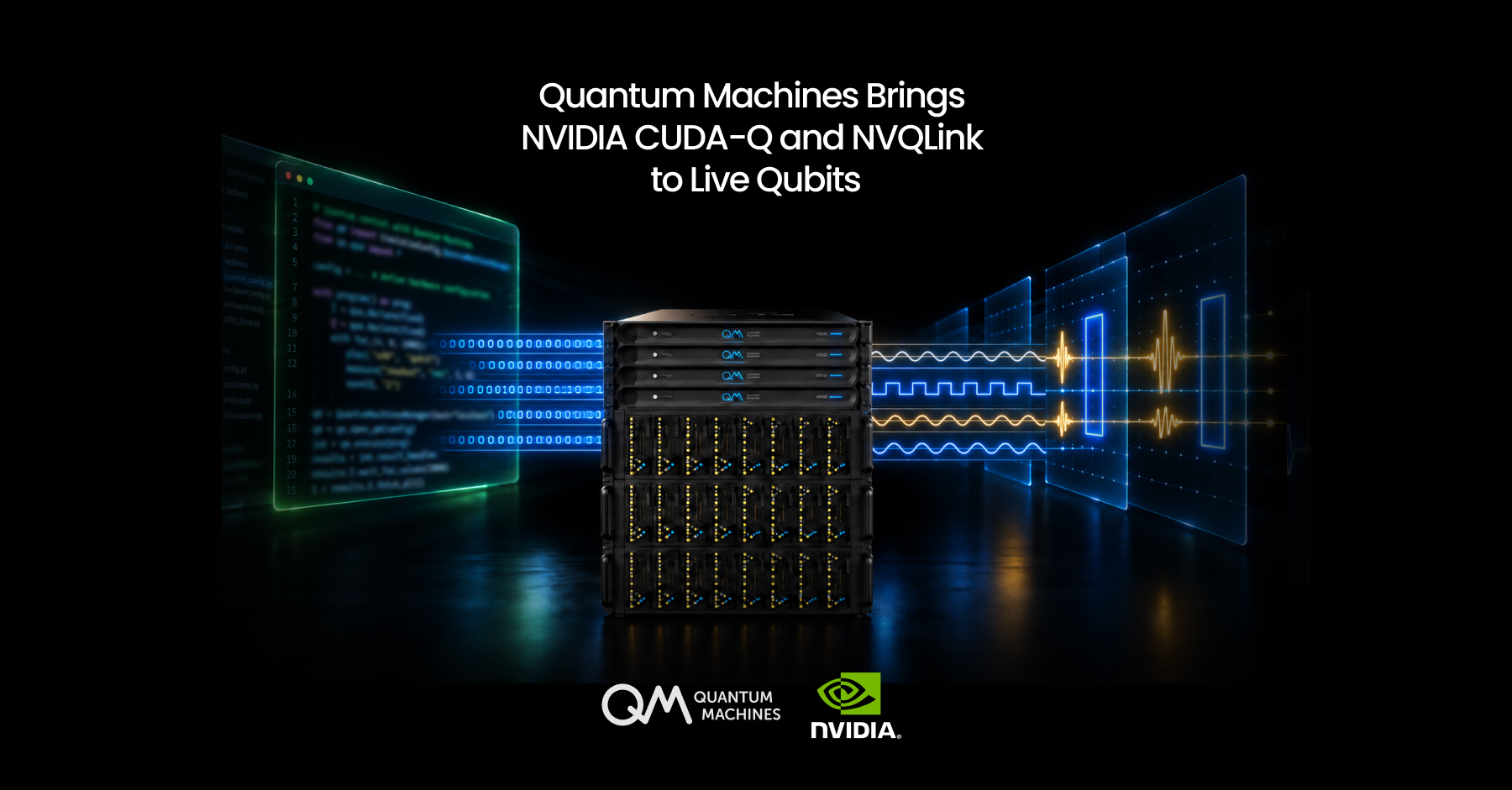
TORONTO, CANADA, September 13, 2026 /EINPresswire.com/ — Quantum Machines, a leading provider of advanced quantum control solutions, today became the first control company to run an end-to-end NVIDIA CUDA-Q program across live qubits and a PPU classical processor with NVIDIA NVQLink. CUDA-Q is NVIDIA’s open platform for quantum-GPU supercomputing, providing a way of writing instructions that both a classical computer and a quantum computer can follow. This enables a software developer to write applications that can easily share quantum and classical resources, taking advantage of the power and reliability of supercomputing in the quantum workflow. NVQLink is the microsecond-speed connection architecture between a quantum controller and GPUs.
This breakthrough demonstration shows how engineers, developers and researchers can run hybrid quantum-classical applications using CUDA-Q, which handles the underlying technical steps automatically in familiar programming languages used across the quantum industry, such as Python, C++, or QUA. This removes the need to hand-code the low-level control sequences that have traditionally required specialist quantum-hardware expertise.
This removes layers of complexity typically required to deploy quantum workloads, reducing time-to-value for research and commercial teams, and moving the industry closer to scalable, application-driven quantum deployments.
Code written once with CUDA-Q was executed on Quantum Machines’ control stack across a quantum processor, GPUs, and CPUs as a unified system, with each part of the job routed seamlessly to the appropriate processor. NVIDIA NVQLink provides a high-speed link in distributing work between conventional computing and the quantum processor. The full exchange completed in about a millionth of a second. Quantum Machines is demonstrating the run live this week at IEEE Quantum Week in Toronto, in front of researchers and engineers from across the industry.
Yonatan Cohen, CTO of Quantum Machines, said: “We have been working closely with NVIDIA for a long time and are very happy to see these technologies and tools come together to enable quantum developers and allow them to move faster towards realizing large-scale quantum computers.”
Today’s QPUs are specialized hardware, much like early GPUs, which were built for research labs, CAD workstations and arcade systems, and programmed by a small number of experts. Over time, GPUs became integrated into mainstream computing, working alongside CPUs as part of a single system. Today’s announcement moves quantum computing further along the same path, bringing QPUs closer to becoming another computing resource that applications can call on when needed.
“Quantum processors become transformative when working tightly alongside GPUs and CPUs as a single unified quantum supercomputing system,” said Sam Stanwyck, Director of Quantum Product at NVIDIA. “Quantum Machines’ demonstration of how CUDA-Q can run hybrid algorithms across qubits connected to GPU supercomputing via NVQLink provides a view of how future supercomputers will operate. .”
Quantum Machines has integrated NVIDIA NVQLink within the Quantum Machines Orchestration Platform, connecting the hardware that drives and reads the qubits directly to NVIDIA accelerated computing through a low-latency link to classical processors. The integration abstracts much of the low-level control and coordination that has typically required specialist quantum-hardware expertise. When a developer writes a program using CUDA-Q, quantum operations are executed on the QPU while CPUs and GPUs can be called in real time; Quantum Machines’ control system converts those operations into the precisely timed signals that control and measure the qubits.
The critical advance is speed: measurement data can reach classical processors, and decisions can return to the quantum control system in microseconds, enabling the real-time interaction required for future workloads such as quantum error correction.
NVIDIA and Quantum Machines have a long history of pioneering low-latency QPU-GPU integrations, and this work with NVQLink is the latest in a series of advancements that are scaling quantum computing towards useful applications.
G Wisniewski
Catchfire PR Ltd
email us here
Visit us on social media:
LinkedIn
YouTube
Legal Disclaimer:
EIN Presswire provides this news content “as is” without warranty of any kind. We do not accept any responsibility or liability
for the accuracy, content, images, videos, licenses, completeness, legality, or reliability of the information contained in this
article. If you have any complaints or copyright issues related to this article, kindly contact the author above.

Media gallery