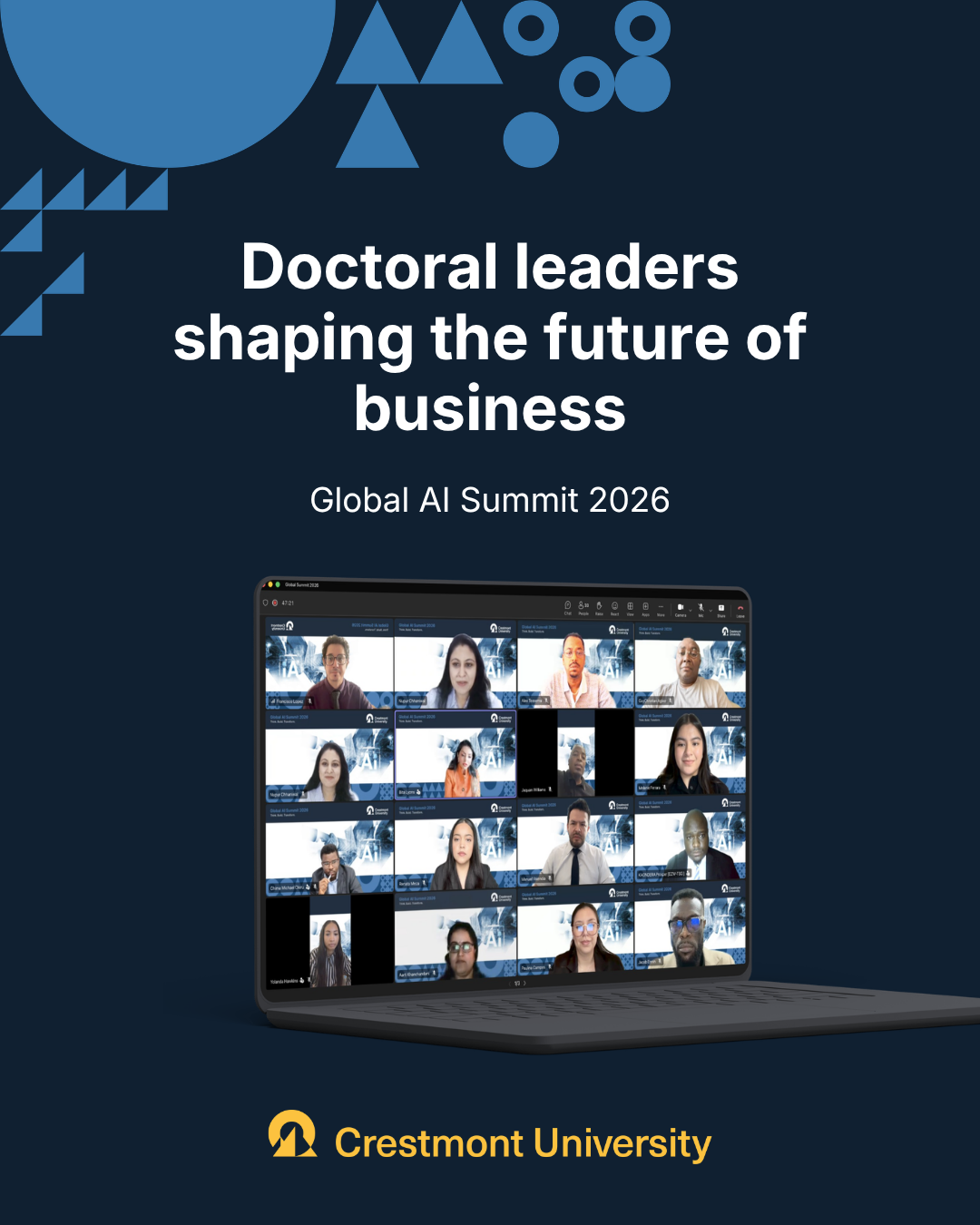
Nine doctoral candidates showcased AI applied research on healthcare, logistics, software development, governance, sustainability, and hospitality.
SIOUX FALLS, SD, UNITED STATES, September 25, 2026 /EINPresswire.com/ — Nine Doctor of Business Administration (DBA) candidates at Crestmont University, presented original, applied research on artificial intelligence at Global AI Summit 2026, a virtual research summit the University hosted on September 10, 2026, under the theme “Think. Build. Transform.” Their research projects addressed live, unresolved business problems in healthcare, logistics, software development, governance, sustainability, and hospitality; direct evidence of the kind of real-world impact Crestmont University’s doctoral students are having through their coursework.
The summit’s central topic “AI-Powered Entrepreneurship: Innovating Sustainable, Ethical, and Scalable Global Enterprises”, reflects where applied business research has moved in recent years. Artificial intelligence adoption inside real organizations rarely comes down to a single technical question; it raises governance, workforce, and sustainability questions all at once. More than 30 DBA candidates from around the world attended the roughly 3.5-hour event to engage with that challenge firsthand.
AI’s Growing Footprint in Global Business
The students’ research lands at a moment when artificial intelligence is reshaping how organizations operate at nearly every level. According to McKinsey’s most recent State of AI survey, 88% of organizations now use AI in at least one business function, up from 78% the year before, and AI adoption is projected to unlock as much as $2.9 trillion in global productivity gains by 2030. Adoption is uneven by sector and by company size, and moving from pilot projects to enterprise-wide impact remains a challenge for most organizations, which is precisely the kind of real, unsettled problem Crestmont University’s Doctoral Research Projects are built to address.
Meet the Doctor of Business Administration Presenters:
Each of the nine Doctoral Research Projects (DRPs) presented at the summit applied AI research to a real, specific business or organizational question.
Bita Lyons
“Scaling Healthcare AI Globally: From Clinical Validation to Sustainable Commercial Adoption”
Examines why healthcare AI tools that clear clinical testing often still fail to reach patients at scale, due to regulatory, reimbursement, and adoption barriers that differ by market.
Alex Tessema
“AI-Driven Forecasting and Workforce Optimization in Ground Logistics Operations”
Applies AI-driven demand forecasting and staffing optimization to ground logistics — one of the most immediately applicable uses of AI in operations management.
Prosper R. Kaondera & Guy Christian Agbor
“Ethical AI, Governance & Responsive Innovation”
Builds governance structures that respond to emerging AI risks in real time, as organizations adopt AI faster than most governance frameworks can keep pace with.
Chimankpam Michael Oleru
“Who Decides? Building Enterprise Decision Systems for Responsive AI Transformation”
Tackles the core tension in enterprise AI adoption: which decisions an AI system should support, and which should remain with a human.
Jacob Ennin
“Generative AI in Enterprise: A Strategic Enabler for Transformation Projects”
Explores how generative AI’s business value depends less on the technology itself and more on how deliberately organizations integrate it into transformation strategy.
Shenkla Khan
“AI-Assisted Development: A Multi-Agent Approach to Software Development Lifecycle”
Investigates multi-agent AI systems — multiple coordinated AI processes working together — as an active area of software engineering research.
Jaquan Williams
“Verde Nexus as an AI-Enabled Sustainability and Global Learning Platform”
Pairs an AI-enabled platform with sustainability and global-learning goals, examining technology built to serve both an environmental and an educational outcome.
Yolanda Hawkins
“Beyond the Machine: AI-Enabled Vending & the Evolution of Hospitality”
Shows how AI is transforming vending machines from passive dispensing equipment into intelligent services infrastructure.
Doctoral-Level Rigor, Real-World Application
Every project traces back to the structure that defines Crestmont University’s DBA: the Doctoral Research Project. A DRP asks a student to take a real organizational problem, apply doctoral-level research to it, and produce a working solution, not just a theoretical paper. Each presenter had 10 minutes to present, followed by a 5-minute question-and-answer session, and all presentation materials went through faculty review in advance of the summit, consistent with the rigor Crestmont University applies to doctoral research.
The University’s DBA program also offers a dissertation pathway, which asks a different question: what new theoretical contribution can this research add to the field? Both paths require the same doctoral-level rigor and faculty supervision; the difference is whether the research is conducted within one organization or contributes to the broader academic literature.
Learn More
Readers interested in research like this can explore the Doctor of Business Administration program at Crestmont University, including its Doctoral Research Project and Dissertation pathways and its four specializations: https://crestmontuniversity.edu/programs/doctorate/dba/
Manuel Valencia Nava
Crestmont University
+ +1 949-359-0045
email us here
Legal Disclaimer:
EIN Presswire provides this news content “as is” without warranty of any kind. We do not accept any responsibility or liability
for the accuracy, content, images, videos, licenses, completeness, legality, or reliability of the information contained in this
article. If you have any complaints or copyright issues related to this article, kindly contact the author above.

Media gallery